How High to Hang Wall Art: A Simple Guide for Canvas Prints
The 145 cm eye-level rule, how to hang art above furniture, and how to space a gallery wall.
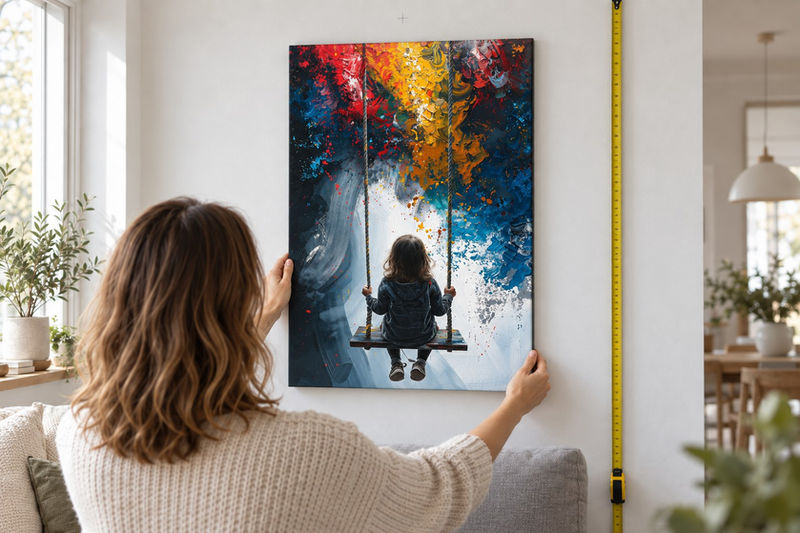
Even a beautiful print looks wrong if it is hung too high. A few widely used guidelines take the guesswork out of it.
The short answer
Hang a picture so that its centre is about 145 cm (57 in) from the floor. Above a sofa, bed or sideboard, use the furniture instead: leave 15 to 25 cm between the top of the furniture and the bottom of the frame. The rest of this guide covers the exceptions.
The eye-level rule
Galleries typically hang art so that the centre of the piece sits at about 145 cm (57 in) from the floor, which is roughly average eye level. Measure to the middle of the canvas, not the top edge. For a 60x90 cm canvas hung vertically, the middle is 45 cm below the top edge, so the top edge would sit at about 190 cm.
Above a sofa, bed or console
When the art relates to a piece of furniture, the bottom edge usually sits about 15 to 25 cm (6 to 10 in) above it. Any higher and the two stop reading as one arrangement. In these rooms the furniture is the anchor and this rule takes priority over the eye-level rule.
Above a sofa: the numbers
Most sofa backs are 80 to 90 cm high, so the bottom edge of the art usually lands at around 100 to 110 cm from the floor. Make the art, or the group, about two thirds as wide as the sofa. A standard 210 cm sofa takes about 140 cm of art: one 60x90 cm canvas on its own looks narrow there, while three 40x60 cm canvases with 6 cm gaps fill 132 cm and read as one piece.
Above a bed
Use the headboard as your baseline and leave 15 to 25 cm between its top and the bottom of the frame. Without a headboard, measure from the top of the mattress and leave a little more, around 30 cm, so you do not touch the art when you sit up. Aim for about two thirds of the bed's width, which is roughly 95 to 105 cm above a 140 to 160 cm double bed. Fix anything above a bed with two points, and prefer canvas or metal prints, which have no glass.
Above a sideboard, chest or console
Leave 20 to 30 cm above the top, a little more than above a sofa, so lamps and objects have room. Keep the art narrower than the furniture, again about two thirds of its width: a 120 cm sideboard takes about 80 cm of art, such as one 60x60 cm square or two 40x60 cm prints side by side.
Large and extra-large pieces
The 145 cm centre still works for big pieces, but check the top edge. A 60x90 cm canvas centred at 145 cm reaches about 190 cm, which suits a standard ceiling. Under a low ceiling, keep at least 30 cm of wall above the frame and lower the centre slightly, rather than letting the art crowd the ceiling.
Gallery walls
- Keep the gaps between pieces consistent, commonly 5 to 8 cm (2 to 3 in).
- Treat the group as one shape and centre that shape at eye level.
- Lay everything out on the floor first, or cut paper templates and tape them to the wall.
On a staircase
On stairs, eye level moves with every step. Measure 145 cm up from the front edge of the step below each picture and mark the centre there. The pictures then follow the slope of the stairs in a diagonal line. Keep the same gap between pieces as you would on a flat wall.
Low and sloped ceilings
Under a ceiling of around 230 to 240 cm, lower the centre slightly, to about 135 to 140 cm, and choose a smaller size or a row of smaller pieces, so that at least 30 cm of wall stays free above the frame. Under a sloped ceiling, hang on the vertical part of the wall where you can, and keep the artwork below the line where the slope begins.
In a child's room
Children see the wall from much lower down. For art that is meant for them, a centre at around 120 cm works better than the adult 145 cm. Above a bed or cot, keep the piece light, fix it with two points and avoid glass.
In a hallway or a dining room
In a hallway people look at art while walking, so the standard 145 cm centre works well. In a dining room people mostly see the walls while seated, which is why a slightly lower centre, around 135 to 140 cm, often looks better there.
Hanging a stretched canvas
Our canvas prints are stretched on a solid wooden frame and arrive with hanging hardware included. Use a wall anchor suited to your wall type for the larger sizes, and a level to check the line before you tighten anything.
Ideas to try
A piece like the Neuschwanstein Castle Canvas Wall Art works well on a hallway wall hung at eye level, while the Misty Forest Cabin Canvas Wall Art suits a cabin or living room wall above a low sideboard. Browse all our canvas and aluminum wall art or find us on our Etsy shop.